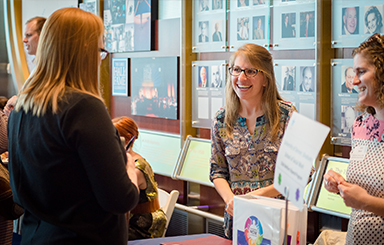
Richard Ball Scholarly Lectures
The purpose of these annual public lectures is to stimulate mathematical research among students at the University of Denver, particularly graduate students transitioning from coursework to research. An award is given to one or more students for their analysis and presentation of a mathematics research paper.
The award was established by a generous donation from mathematics alum Dr. Aditya Nagrath and Elephant Learning. It honors emeritus professor Richard Ball, a long-term faculty member and chair of the Department of Mathematics.
-
2026 Lectures
May 27, 2 - 2:30 pm, CMK room 309
Jessamyn DukesTitle: Arithmetic Data for Delsarte K3 Surfaces
Abstract: We present results from a systematic arithmetic study of all Delsarte quartic K3 pencils, including explicit decompositions of their corresponding L-functions into hypergeometric and zeta factors. This talk is based on joint work with Rachel Davis, Thais Gomes Ribeiro, Eli Orvis, Adriana Salerno, Leah Sturman, and Ursula Whitcher; paper to appear in Research in the Mathematical Sciences.
May 27, 2:30 - 3 pm, CMK room 309
Eden KetchumTitle: On the Fields Generated by the Character Values of Finite Groups
Abstract: Given a character of a finite group, we can obtain a field by adjoining all of the elements of its image to $\mathbb{Q}$. The study of these fields has proven fruitful in recent times. In this talk we discuss the fields $\mathbb{Q}(G)$, which are obtained by adjoining the values of all the irreducible characters of a finite group $G$ to $\mathbb{Q}$. We will discuss many of the existing results on these fields and the calculation of these fields for certain finite groups of Lie type.
May 27, 3 - 3:30 pm, CMK room 309
Samuel MarshallTitle: A motivated Proof of the Bressoud-Göllnitz-Gordon Identities
Abstract: We present what we call a “motivated proof” of the Bressoud-Göllnitz-Gordon partition identities. Similar “motivated proofs” have been given for the Rogers-Ramanujan, Gordon’s, Andrews-Bressoud, and the Göllnitz-Gordon-Andrews partition identities. In our proof, we introduce “ghost series” similar to those introduced in the motivated proof of the Andrews-Bressoud identities and use recursions similar to those in the motivated proof of the Göllnitz-Gordon-Andrews identities. We anticipate that this motivated proof of the Bressoud-Göllnitz-Gordon identities will illuminate certain twisted vertex-algebraic constructions. This work is joint with John Layne, Christopher Sadowski, and Emily Shambaugh.
May 27, 3:30 - 4 pm, CMK room 309
Christian NaessTitle: Relativizing Logical Systems to Reduce the Complexity of Axioms
Abstract: The study of formal logical systems has its origin in Hilbert calculi; systems which have a large class of axioms and one inference rule (modus ponens). A disadvantage of Hilbert systems is that various proof theoretic properties (such as interpolation) are difficult to verify. Alternate logical systems that are more amenable to proof theoretic study are Gentzen-style sequent calculi. These systems have a small class of axioms and a larger class of inference rules which in some sense capture the meaning of Hilbert-style axioms. As a consequence, sequent calculi have a system of rules tailored to represent the desired axioms; however, as axioms increase in complexity, so too does the complexity of the required rules.
There are axioms (such as distributivity) which are too complex for standard techniques of sequent proof theory to adequately handle. By relativizing sequent calculi and axioms to a distributive setting, we can reorder the complexity of axioms to bring some axioms that were previously too complex to analyze, to a lower complexity relative to the presence of distributivity.
May 29, 2-4 pm, CMK room 207
Brendan DuftyTitle: Non-Distributive Duality for Brouwerian Algebras and their Algebras of Fractions
Abstract: Based on the landmark results of Stone, Esakia, and Priestley, duality theory has become a powerful tool for investigating logics and their associated algebraic structures. This talk will serve as an introduction to duality theory before diving into the specifics of my joint work with Nick. In particular, most previous logical dualities have worked with algebraic structures that are distributive, whereas algebras of fractions do not possess this property. By uncovering a better-behaved join-irreducible spine inside these algebras of fractions, we can recover the simplicity that is a hallmark of duality results, while also (somewhat) sidestepping the non-distributivity our structures are afflicted with. All of this culminates in a novel poset category that is dual to a subcategory of algebras of fractions, which is in turn equivalent to pointed Brouwerian algebras.
May 29, 2-4 pm, CMK room 207
Zion HeftyTitle: Improving R(3,k) in Just Two Bites
Abstract: The Ramsey number R(t,k) is the smallest n such that any red-blue edge coloring of the n-vertex complete graph has either a t-vertex red complete subgraph or a k-vertex blue complete subgraph. We will investigate the history of asymptotic bounds on the extreme off-diagonal Ramsey numbers R(3,k) and present a new lower bound that has been conjectured to be asymptotically tight.
May 29, 2-4 pm, CMK room 207
Luke HetzelTitle: Finding Sumsets in Sets of Natural Numbers
Abstract: In 2019 Moreira, Ritcher and Robertson proved a long-standing conjecture of Erdős, showing every subset of the naturals with positive upper Banach density contains a subset of the form B+C with B and C infinite. In this talk we will survey a collection of related topics including the growth rate and computability of such sets. In general we ask the question (and provide some partial answers), "how easy is it to find the sumsets that the result of Moreira, Richter and Robertson guarantees?"
May 29, 2-4 pm, CMK room 207
Paul JohnsonTitle: Complicating a Simple Idea: Simplicial Complexes as Abstract Tools
Abstract: Simplicial complexes are one of the most intuitive and introductory approaches to understanding invariants of a topological space, such as homology. As it turns out, these basic tools have profound connections to other areas of mathematics. Simplicial sets, i.e. presheaves on the simplex category Δ, allow for the transport of topological intuition to all sorts of algebraic contexts, such as group cohomology and ∞-categories. This talk will attempt to start from basic geometric intuition around simplicial complexes, build up a notion of a simplicial set, and then use these tools to define the Hochschild cohomology for associative algebras, which plays a key role in the deformation theory of associative algebras. These ideas will then be taken even further to describe an analogous cohomology theory for grading-restricted vertex algebras. Hopefully there will be something in this talk for everyone to enjoy.
-
2025 Lectures
June 5, 3:00-3:30, CMK 100
Paul Johnson: Introducing Vertex Algebras and Deformation Theory
June 5, 3:30-4:00, CMK 100
Luke Hetzel: Infinite Configurations in the Naturals
June 11, 2:00-2:30, CMK 309
Eden Ketchum: Characters and Sylow Subgroup Generation
June 11, 2:30-3:00, CMK 309
Di Qin: Curvature and strongly regular graphs
June 11, 3:00-3:30, CMK 309
Zion Hefty: Word-representations, representation numbers, and poset dimensions
-
2024 Lectures
April 26, 2:00-2:30pm, CMK 309
Evans Hedges: Equilibrium States and Topological Pressure - An overview of important questions in Dynamical Systems and Thermodynamic FormalismApril 26, 2:30-3:00pm, CMK 309
Kempton Albee: A recipe for Canonical Formulas in Substructural LogicsMay 22, 4:00-4:30pm, CMK 309
Luke Hetzel: The Sum Also Rises: Relating Sets of Recurrence to Infinite SumsetsMay 22, 4:30-5:00pm, CMK 309
Eden Ketchum: The McKay-Navarro conjecture