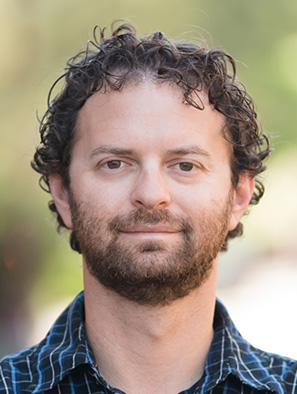
Scott Horowitz
Associate Professor
303-871-4326 (Office)
Engineering & Computer Science Building, 2155 E. Wesley Ave. Denver, CO 80208
What I do
I research and teach biochemistry, and often try to fuse those two pursuits.Specialization(s)
structural biology, biochemistry, biophysics, and bacterial genetics<br>science education
Professional Biography
I began my scientific career studying nucleic acid structure and energetics at Wesleyan University, before moving to the University of Michigan for graduate school, co-mentored by Profs. Raymond Trievel and Hashim Al-Hashimi, studying unconventional hydrogen bonding and biological methylation. For my postdoctoral studies, I stayed at the University of Michigan and joined Prof. James Bardwell and the Howard Hughes Medical Institute, studying molecular chaperones. In 2017, I joined the Chemistry & Biochemistry department and the Knoebel Institute for Healthy Aging at the University of Denver. My laboratory primarily studies how nucleic acids affect protein folding and aggregation, and I also work on how to improve science education through gaming. Outside of the lab and classroom, I enjoy singing and music.
Degree(s)
- Ph.D., Biophysics, University of Michigan, 2013
- MA, Chemistry, Wesleyan University, 2008
- BA, Molecular Biology & Biochemistry, Wesleyan University, 2007
Research
Molecular chaperones combat myriad stress conditions that cause protein misfolding and aggregation and thus are essential for cell survival. These molecular chaperones are critical for maintaining the health of the proteome (termed proteostasis), which is of prime importance to human health. Defects in proteostasis are linked to many crippling diseases, including Alzheimer’s disease, Parkinson’s disease, Huntington’s disease, and ALS. Our inability to treat many of these protein-folding disorders stems, in part, from our lack of knowledge about the underlying mechanisms molecular chaperones use.
It has long been known that nucleic acids carry the genetic information necessary for life. Nucleic acids also play vital structural, catalytic, and regulatory roles in the cell. Very recently, we discovered that nucleic acids perform an additional unsuspected but crucial task—preventing protein aggregation as molecular chaperones. We showed that nucleic acids possess very potent anti-aggregation activity. By weight, RNA is at least an order of magnitude more abundant in the cell than known chaperone proteins, and in vitro, we found that RNA is 5- to 300-fold more effective at preventing protein aggregation. Moreover, we showed that RNA can work with cellular protein folding machinery to refold denatured proteins. These findings raised the possibility that RNA plays a sizable and possibly dominant role in protein stability in the cell. Currently, we know virtually nothing of the principles by which nucleic acids with chaperone activity function, the extent of their abilities, or of the mechanism by which they interact and cooperate with other protein chaperones. Knowledge of how nucleic acids affect protein aggregation will provide crucial insights into the alternative mechanisms that cells developed to prevent toxic aggregation and disease. The work in the Horowitz lab is focused on understanding this phenomenon.
It has long been known that nucleic acids carry the genetic information necessary for life. Nucleic acids also play vital structural, catalytic, and regulatory roles in the cell. Very recently, we discovered that nucleic acids perform an additional unsuspected but crucial task—preventing protein aggregation as molecular chaperones. We showed that nucleic acids possess very potent anti-aggregation activity. By weight, RNA is at least an order of magnitude more abundant in the cell than known chaperone proteins, and in vitro, we found that RNA is 5- to 300-fold more effective at preventing protein aggregation. Moreover, we showed that RNA can work with cellular protein folding machinery to refold denatured proteins. These findings raised the possibility that RNA plays a sizable and possibly dominant role in protein stability in the cell. Currently, we know virtually nothing of the principles by which nucleic acids with chaperone activity function, the extent of their abilities, or of the mechanism by which they interact and cooperate with other protein chaperones. Knowledge of how nucleic acids affect protein aggregation will provide crucial insights into the alternative mechanisms that cells developed to prevent toxic aggregation and disease. The work in the Horowitz lab is focused on understanding this phenomenon.
Areas of Research
protein folding and aggregation<br>DNA and RNA function<br>scientific gaming and education
Key Projects
- Investigating the Chaperone Activity of Nucleic Acids